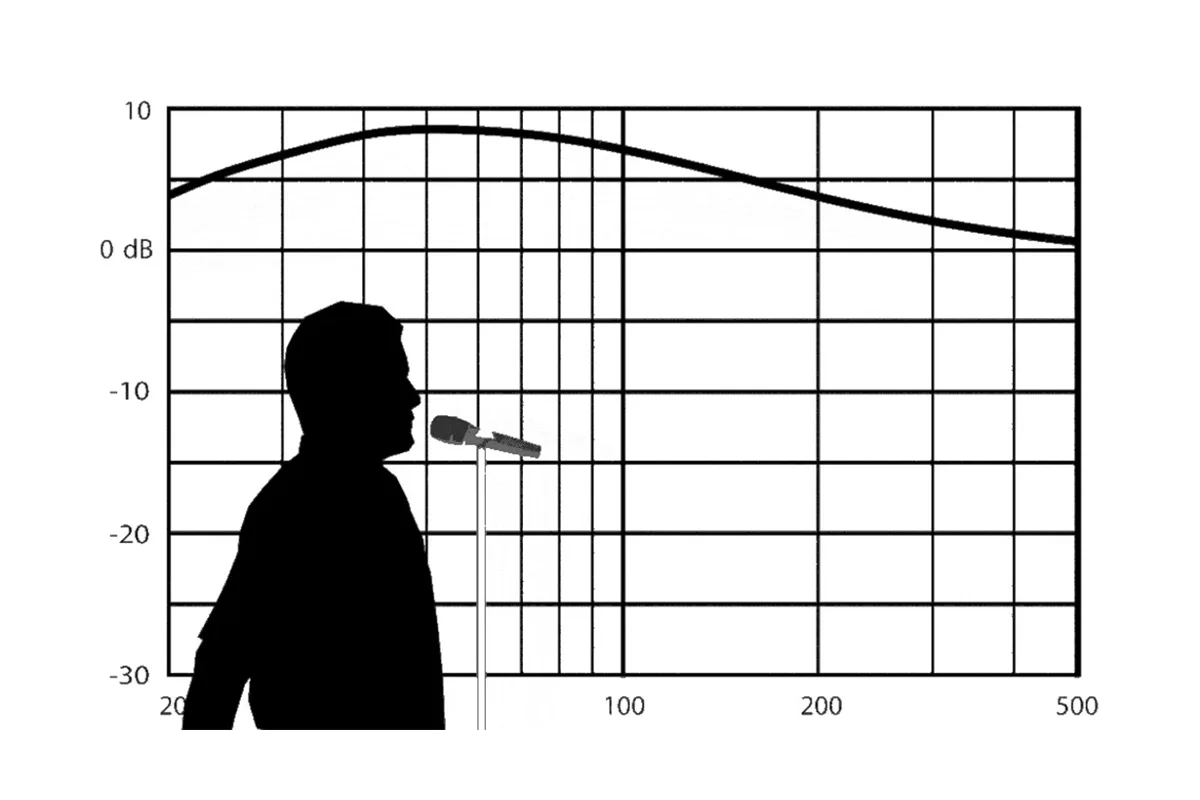
More Bass Through Proximity: The Proximity Effect in Microphones
Are you familiar with this phenomenon? When a voice is brought very close to a vocal or broadcast microphone, it suddenly sounds fuller, more intimate, and extremely bass-heavy. The sound becomes noticeably thinner if you move further away. This is caused by what’s known as the proximity effect.
Why does this effect occur?
It occurs exclusively with pressure-gradient microphones, i.e., all directional microphones, such as cardioid, supercardioid, or figure-8. It occurs because the sound hits both the front and back of the diaphragm. If the sound source (such as your mouth or an instrument) is very close to the microphone (less than 1 m), the pressure ratio between the front and back changes drastically at low frequencies, resulting in a natural boost in the bass range.
Good to know: Pure pressure-sensitive microphones (omnidirectional microphones) do not exhibit this effect. With these microphones, the frequency response remains completely neutral and unchanged, even at very close range.
A Blessing or a Curse in the Studio?
Creative uses: Radio hosts, podcasters, and singers appreciate this effect for adding warmth, volume, and presence to thin voices.
The challenge: With instruments or inexperienced speakers, the sudden boost in bass can quickly lead to a muddy or boomy sound. The choice of polar pattern also makes a big difference—the more directional the pattern (up to figure-8), the more intense the bass boost.
Furthermore, different instruments respond uniquely. For example, a grand piano, as a surface radiator, hardly produces any close-range sound, while a kick drum behaves almost like a point source and requires careful microphone selection.
Would you like to gain deeper insights and see precise measurement curves on this topic? The microphone manufacturer DPA Microphones offers an excellent, detailed technical article on this subject by Eddy Bøgh Brixen in its Mic University.